


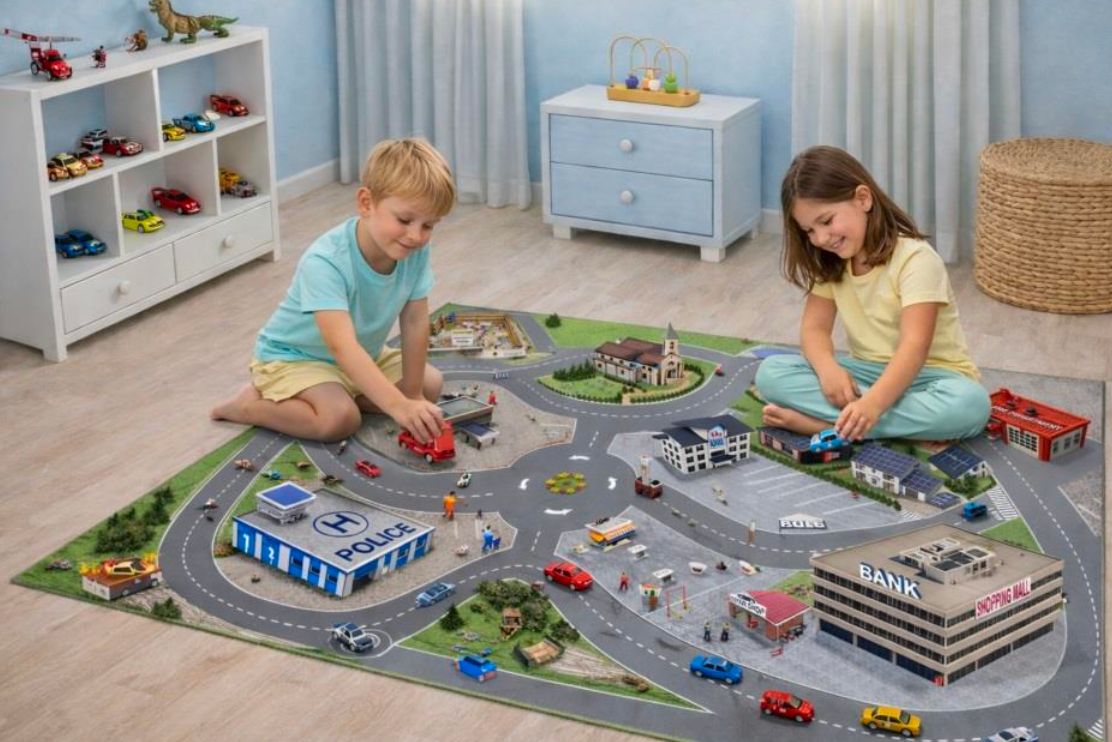
Playing together creates memories, fosters imagination, and gets children talking to each other. City Street Play Mat
Why is free play so important? Children don't need perfect play instructions to learn. Often, an exciting play world, a few figures, and plenty of imagination are enough.
Today, a small car might become a fire engine. Tomorrow, the same vehicle transports animals to a farm, and the next day it embarks on an exciting journey to an airport. For children, this is completely natural. They create their own stories and discover their world in a completely natural way.
This is exactly where the special strength of free play lies.
Children are allowed to decide for themselves, to try things out, to change them, and to start over. They experience that their ideas are important and that there is often more than one right way. This self-determined exploration not only strengthens imagination but also self-confidence.

At Fineline Creatives, we want to support exactly this idea. Our play worlds deliberately do not prescribe ready-made stories. They invite children to develop their own adventures and to come up with new ideas again and again together with siblings, friends, or family.
We also care that as many children as possible can play together. Every child brings their own interests, abilities, and strengths. That is why we design our products to be as open as possible, so that playing together becomes an experience for many children.
The most important benefits at a glance
- Children develop their own ideas.
- Imagination and creativity are fostered.
- Language develops naturally through play.
- Children learn to find solutions together.
- Self-confidence grows through their own experiences.
- Playing is fun and brings people together.
Good to know
The American Academy of Pediatrics describes free play as an important part of a healthy childhood. Through it, children develop, among other things, creativity, problem-solving skills, self-regulation, and social skills.
What does free play mean?
Free play means that children decide what they play and how their story continues. There are no fixed rules, no right solution, and no time pressure. Children decide for themselves which figures they use, what roles they take on, and which ideas they want to try out.
This freedom is exactly what makes the difference. Children experience that their imagination is needed and that they can change their play world at any time. This is how new stories are constantly created, and every game feels a little different.

Open play worlds give children space for their own ideas and promote creative play. Farm Play Mat
Free play or play with fixed rules?
Free play
- Children decide for themselves
- Imagination takes center stage
- Original ideas are encouraged
- Every round of play is different
Play with fixed rules
- The course of play is predetermined
- The goal is often fixed
- Solutions are usually predetermined
- The sequence is often repeated
What do children learn through free play?
Children often learn more through play than they realize. While letting their imagination run wild, they gain experience, make decisions, and develop skills that accompany them in everyday life.
The special thing about it: Learning happens without any pressure. Children discover their environment with curiosity and joy and decide the pace of their play for themselves.
How does free play support your child's development?
Free play simultaneously supports many areas of childhood development.
Creativity and imagination
Children develop their own ideas, make up stories, and discover new ways to play again and again.
Language development
By telling stories, explaining, and role-playing together, children playfully expand their vocabulary and learn to express their thoughts.
Social skills
Playing together promotes consideration, communication, and respectful interaction with one another. Children learn to listen, resolve conflicts, and make decisions together.
Self-confidence
Implementing their own ideas and overcoming small challenges strengthens their confidence in their own abilities.
Concentration and problem-solving skills
Children often stay with a self-chosen play idea for a long time and independently think about how they can overcome obstacles or further develop their story.

Role-playing games stimulate the imagination and invite children to experience new adventures every day.
Which toys are particularly suitable for free play?
Not every toy encourages children to play freely in the same way. Play materials that leave many possibilities open and stimulate the imagination are particularly suitable.
These include, for example:
- Play mats with open play worlds
- Play figures and animals
- Vehicles
- Building blocks
- Costumes for role-playing
- Everyday objects that can be used creatively
The less that is predetermined, the more room there is for original ideas.
💡 Good to know: Children don't need as many toys as possible. Often, the best play ideas arise from a few versatile materials that leave room for imagination and original decisions.
How can parents promote free play in everyday life?
Children don't need new toys every day. What is much more important are time, trust, and an environment that invites exploration. Even small changes in everyday life can help children give their imagination more room.
📌 Checklist: How to promote free play
- Plan time for free play every day
- Choose play materials that offer many possibilities
- Do not prescribe or interrupt every play idea
- Allow playing together without directing the play
- Value imagination and original ideas
💡 Did you know? Studies show that children learn particularly intensively when they can decide for themselves how they play. Personal experience often promotes sustainable learning more effectively than predetermined routines.
Why is playing together so valuable?
Playing together brings people together. Children learn to share their ideas, take each other into consideration, and find solutions together. At the same time, they experience how enriching different perspectives can be.
At Fineline Creatives, we want to design play worlds that make this possible. Our designs are deliberately kept open so that children can develop their own stories and as many as possible can play together—regardless of their individual abilities or prerequisites.
🌱 Our philosophy
Play brings people together.
We believe that every child should have the opportunity to live out their imagination, discover new things, and experience unforgettable moments of play together with others. That is why we develop play worlds that are open, versatile, and long-lasting, so that children can invent new adventures again and again.
✔️ The most important things at a glance
- Free play strengthens development in many areas.
- Children learn best through their own experiences.
- A few versatile play materials are often completely sufficient.
- Playing together promotes communication and cohesion.
- Imagination is one of the most important foundations for creative learning.

Why does playing together strengthen the whole family?
Playing together means much more than just spending time together. When parents, grandparents, or siblings play together with children, valuable moments full of imagination, conversation, and shared experiences are created. Children feel seen, taken seriously, and experience that their ideas are important.
It is not about directing the play or setting rules. The best moments of play often arise when adults simply play along and pick up on the children's imagination.
What benefits does playing together have?
Shared playtime has a positive effect on the whole family.
✔ More time together
Even a few minutes of mindful play each day create valuable family moments.
✔ Better communication
Through play, children and adults naturally get into conversation with each other.
✔ More confidence
Children experience that their ideas are taken seriously and develop greater self-confidence.
✔ Stronger family bonds
Shared experiences create memories that often last a lifetime.
✔ Less screen time
Creative moments of play offer a varied alternative to digital media.

Frequently Asked Questions (FAQ)
From what age is free play beneficial?
Free play begins as early as infancy. Even babies and toddlers discover their surroundings through play and develop their first skills. As they get older, role-playing, creative stories, and playing together become increasingly important for healthy development.
How long should my child play freely every day?
There is no fixed time limit. What is much more important is that children regularly have time to follow their imagination without instructions or pressure to perform. Even short, uninterrupted periods of play can positively support development and have an enriching effect.
Which toys promote free play particularly well?
Play materials that leave many possibilities open and do not prescribe a fixed course of play are particularly suitable. These include play mats, play figures, vehicles, building blocks, or costumes—anything that creates room for original ideas.
Why is boredom sometimes important?
Boredom is often the starting point for new ideas. When children are not constantly kept busy, they often begin to get creative themselves and develop their own play ideas that stimulate their imagination.
Does free play also promote social skills?
Yes, absolutely. Through playing together, children learn to listen, take others into consideration, resolve conflicts, and make decisions together. These valuable experiences are an important part of their social development.
Should parents join in the play?
Yes—but without directing the play. Children benefit particularly when adults pick up on their ideas and immerse themselves in their fantasy world together, rather than prescribing rules or solutions.
Can free play support my child's development?
Free play can positively support many areas of childhood development. These include creativity, language, concentration, problem-solving skills, self-confidence, and social skills—all abilities that will accompany your child throughout their life.
Why are play mats particularly suitable for free play?
Play mats create an open play world that children can discover anew again and again. They invite children to invent stories, develop role-playing games, and play creatively with others—without predetermined boundaries.
Conclusion
Free play is much more than a pleasant activity. It helps children discover their world with imagination, curiosity, and creativity. At the same time, it promotes language, social skills, self-confidence, and independent thinking.
Children do not need perfect play conditions for this, but above all time, trust, and an environment that leaves room for original ideas.
At Fineline Creatives, we want to support exactly these moments of play. Our play worlds invite children to invent stories, play together, and let their imagination run wild again and again every day.
Sources and further information
You can find further information and scientific background on this topic from the following professional organizations and institutes, among others:
- American Academy of Pediatrics (AAP) – The Power of Play: A Pediatric Role in Enhancing Development in Young Children (2018)
- UNICEF – Learning through Play
- Center on the Developing Child, Harvard University
- The LEGO Foundation – Learning Through Play
- National Association for the Education of Young Children (NAEYC) – Information on the importance of free play in early childhood development


